


Nail Salon: ASMR Simulator
3.42.00 Reviews
App Specs
- Version
- 1.0.3
- Updated On
- License
- Free
- Downloads
- 100,000+
- Developer
- WeGit Technologies
- Categories
- Simulation
- Platform
- Android
Screenshots




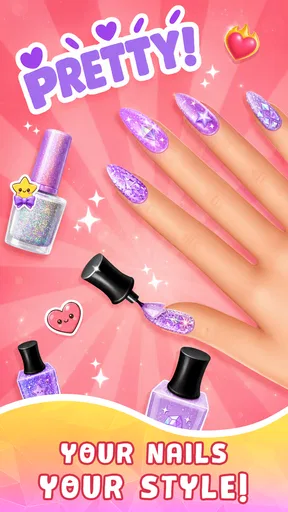
 Analysis by AppCompare
I spent time with Nail Salon: ASMR Simulator as a light fashion game rather than a serious salon-management experience, and that distinction matters from the first few minutes. It is a free simulation game from WeGit Technologies built around nail makeovers and three-dimensional styling. The appeal is easy to understand: you can settle into a small creative task, experiment with a look, and enjoy the visual satisfaction of turning an ordinary set of nails into something more polished.
My overall impression is mixed but fairly clear. The game is approachable, suitable for Everyone, and likely to appeal to players who want a simple beauty activity without a complicated tutorial or demanding strategy layer. At the same time, its modest average rating of 3.4 suggests that the experience will not satisfy every player equally. I would recommend trying it when you want a short, low-pressure distraction, but I would not treat it as a deep simulation or a replacement for a more feature-rich fashion game.
How the nail makeover experience feels in everyday play
The best way to understand this game is to imagine opening it during a small break. Perhaps I have a few minutes before leaving home, or I want something calmer than a competitive game. A nail-styling session fits that moment well because the task has an obvious visual goal. I can focus on the appearance in front of me instead of learning a large map, tracking several resources, or remembering a long chain of objectives.
That simplicity is also the main design trade-off. A game based on nail makeovers needs to make the creative actions feel rewarding, and the three-dimensional presentation gives the activity more presence than a flat menu would. However, players who expect a detailed salon business, customer scheduling, staff management, or a large progression system may find the concept narrower than the word “simulation” initially suggests.
I found the strongest use case to be casual creative play. It works for someone who enjoys beauty themes, color combinations, and visual before-and-after changes. It can also suit a younger player because the age classification is Everyone and the central idea is easy to grasp. Parents should still make their own judgement about whether the style and any surrounding elements fit their child, but the stated age category makes the game broadly accessible.
The important expectation to set is this: Nail Salon: ASMR Simulator is most convincing as a relaxing makeover activity, not as a detailed professional salon simulator. That expectation makes its short sessions feel purposeful instead of incomplete.
What happens when you want quick results
Perceived speed is especially important in a game like this. Players usually open a casual nail app expecting to reach the creative part quickly. If the route from launch to styling is straightforward, the game benefits because the player can enjoy a small session without making a large commitment. If the opening feels slow or repeatedly interrupts the activity, the limited scope becomes more noticeable.
Worth Reading Before You Choose

Flipboard Shows What News Apps Must Do Beyond the Feed

Switching to Android Auto Means Rethinking Your Driving Routine

Google Calendar Makes a Crowded Week Easier to Manage

Ludo King Makes the Most of the Minutes Between Plans

Baby Panda World Brings Quick Play to Modern Phones, but Its Game Library Feels Busy

ESPN’s Live Game View Makes Following Close Games Easier
In practical terms, I would approach it as a game for short visits rather than an app I leave open all day. That is not necessarily a weakness. A focused makeover can be more enjoyable when it ends before the idea becomes repetitive. The game’s free price also lowers the barrier to trying it, so a player can judge the pace personally without first deciding whether a purchase is worthwhile.
One useful habit is to play with a specific creative goal. Instead of tapping through without a plan, I might decide to build a soft pastel look, a bold contrast, or a style that matches an outfit I am wearing. This gives the session direction and makes the visual choices feel more deliberate. It also helps reveal whether the available styling experience is satisfying enough for my taste.
For someone who wants instant, nearly passive entertainment, the game may feel more involved than a simple scrolling app. For someone who wants a quiet activity with a visible result, that small amount of interaction is the point. The right choice depends less on technical ambition and more on whether I enjoy making aesthetic decisions one step at a time.
Where longer or heavier play can expose friction
The moments most likely to test the experience are not necessarily the first makeover. They are the repeated sessions, the transitions between actions, and any point where the game has to display detailed three-dimensional visuals. A single short session can feel perfectly comfortable, while extended use may make repetition or device warmth more noticeable. I would therefore avoid judging the game only by its opening impression.
Three-dimensional beauty presentation can look more appealing than a flat interface, but it may also ask more from a phone than a simple two-dimensional puzzle. Older or entry-level devices can have a different experience from newer hardware, especially if the screen is busy or several visual elements appear together. I would keep other demanding apps closed if the game feels less responsive than expected, and I would avoid assuming that every phone will behave identically.
There is also a practical trade-off between detail and battery comfort. A visually focused game can be pleasant for a short break but less suitable for a long commute if the device is already low on power. I would not install it specifically for extended offline-style sessions unless I had already tested how my own phone handles it. That is not a claim about a particular battery drain figure; it is simply sensible caution with a three-dimensional game.
Another heavy-use issue is attention. Nail styling looks relaxing, but repeated visual decisions can become tiring if every session follows the same rhythm. I would use it in bursts, then switch to another activity when the creative choices stop feeling enjoyable. That approach makes the game’s narrow focus work in its favor instead of turning it into a chore.
Stability, recovery, and what I would do after an interruption
Reliability matters even in a small casual game because the entire appeal depends on an uninterrupted flow. When I am making a look, an unexpected interruption is more irritating than it would be in a game where progress is constantly saved between large stages. The safest approach is to treat each session as a contained activity and avoid closing the game in the middle of an important makeover until I know how it handles returning from the background.
If the game stops responding or needs to be reopened, I would begin with ordinary recovery steps: return to the home screen, launch it again, and make sure the phone has enough free working space. If that does not help, restarting the device is a reasonable next step. I would also keep the game updated, since the current version is 1.0.3 and later maintenance can matter for compatibility and stability.
I do not see a reason to keep it running continuously. Closing it after a session reduces the chance of returning to a stale screen and is kinder to a phone that is already handling many background tasks. This is particularly useful on older devices running the minimum supported operating system, Android 7.0. A game may install on an older system and still feel less comfortable there than on newer hardware.
Recovery expectations should remain modest. I would not build a long, carefully planned play session around the assumption that every interruption will preserve the exact state I was viewing. The game is better suited to flexible play, where losing a short styling attempt is disappointing but not disastrous. That mindset makes occasional friction easier to tolerate.
Device fit, storage choices, and the Android audience
The game supports Android devices starting with version 7.0, which gives it a broad potential audience. Still, operating-system compatibility alone does not tell me how smooth the experience will feel. Screen size, available memory, processor age, and the number of other apps active in the background can all affect a three-dimensional title. On a compact or older phone, detailed nail work may feel less comfortable simply because the controls and visual details have less room.
I would test it first on the device where I actually plan to play, rather than assuming that a positive experience on a newer phone will transfer perfectly. If the game feels slow during transitions, freeing some storage and closing demanding apps are sensible first adjustments. If the phone becomes warm during a longer session, I would shorten the play period instead of forcing a full evening of use.
The install base is already over 100 thousand, so this is not an obscure experiment with no audience at all. That level of reach makes it easier to see the game as a casual title worth trying, though it does not guarantee that it will suit every device or every player. The small number of published reviews—two—also means I would place more weight on my own trial than on a broad consensus.
There is a useful distinction between “can run” and “feels good to use.” A phone that meets Android 7.0 may launch the game, yet a newer device could provide a more comfortable experience for visual styling. Players with limited storage should also consider whether they will keep the game after a few sessions. Since it is free, trying it is easy; keeping it installed should depend on whether the makeover loop continues to feel fresh.
How it compares with other casual beauty games
Compared with a simple dress-up app, this game has a narrower canvas but a more focused activity. Dress-up alternatives usually offer broader outfit decisions and may be better for players who want to create a complete character look. Nail Salon: ASMR Simulator is the better fit when the small details of a manicure are the part I actually enjoy.
Compared with a traditional management simulation, it is likely to feel lighter. A management game normally asks me to balance money, upgrades, customer satisfaction, schedules, or business growth. Here, the attraction is the makeover itself. Players who want planning and long-term consequences should choose a deeper simulation instead; players who find those systems tiring may appreciate this more direct format.
It also differs from competitive fashion games. There is no reason for me to approach it as a contest where speed, ranking, or social comparison is the main reward. Its value is personal experimentation. That makes it suitable for a quiet break, but less suitable for someone who needs a strong sense of challenge or a reason to return every day.
The three-dimensional styling is the feature that gives it a distinct identity, yet it is also where expectations need care. Visual presentation can make nail work feel tactile and satisfying, but it cannot by itself create unlimited depth. If the available choices or sequence of actions feel familiar after repeated sessions, a broader beauty game may offer more variety.
Small techniques that make the experience better
My first practical tip is to decide on a color relationship before starting. Choosing a main shade and then adding a contrasting or complementary detail makes the result look intentional, even when the game is designed for casual play. This is more satisfying than selecting every option independently and hoping the final look comes together.
Second, I would use the three-dimensional view as a checking tool rather than rushing through it. Rotate attention across the whole nail set and look for balance between the individual nails. A design that looks attractive on one nail may feel uneven when viewed as a group. That simple pause turns the game from random tapping into a small composition exercise.
Third, I would separate experimentation from completion. On one session, I might try unusual combinations without worrying about the final result. On another, I would aim for a clean, coordinated style. This two-mode approach helps prevent the game from feeling repetitive because I am giving myself different reasons to play.
Fourth, I would avoid using it as a background activity while the phone is already overloaded. The game’s visual focus deserves the screen, and closing video, social, or other demanding apps can make the session more comfortable. This is especially relevant on older hardware, where the difference between a tidy background and a crowded one can be noticeable.
Who should try it, and who should skip it
I think the game is a good match for players who enjoy beauty themes, want a free casual experience, and prefer a clear activity over a complicated progression system. It can work for a short relaxation break, a child-friendly creative pastime, or anyone who likes comparing color and decoration ideas without needing a competitive objective.
I would be more cautious recommending it to players seeking a complete salon business, detailed customization across many categories, or substantial long-term strategy. It is also not my first choice for someone whose priority is maximum technical smoothness on an older phone. In that situation, a simpler two-dimensional beauty game may be more comfortable and less demanding.
The game’s average rating of 3.4 reflects that middle-ground position. It is not a clear failure, but it is also not a universal recommendation. The experience depends heavily on whether the player values a focused nail makeover loop. If that specific idea sounds appealing, the free download makes trying it reasonable. If the concept already sounds too narrow, no amount of casual accessibility will fully solve that mismatch.
My performance verdict after weighing the trade-offs
WeGit Technologies has created a straightforward simulation game with an appealingly specific premise. The three-dimensional nail styling gives casual beauty play a more tactile feel, and the low-pressure structure makes it easy to pick up for a short session. The Everyone age classification and free price widen its audience, while support from Android 7.0 means many older devices can at least consider it.
My reservation is that the same simplicity that makes it accessible can limit its staying power. Repeated play may feel less rewarding for users who want deeper salon systems, broader fashion choices, or stronger progression. Device performance is another personal variable: newer phones should be the safer choice for comfortable visual play, while older hardware may require shorter sessions and fewer background apps.
For me, the right recommendation is conditional but positive. I would suggest installing it if you want a focused nail makeover game for occasional creative breaks and you are comfortable with a relatively narrow simulation concept. I would skip it in favor of a deeper management or dress-up alternative if you need extensive customization, strategic growth, or a more demanding challenge.
In short, Nail Salon: ASMR Simulator works best when I treat it as a small, visual relaxation game rather than a full salon career. Keep sessions flexible, give each makeover a simple creative goal, and judge smoothness on your own phone. With those expectations, it can be an enjoyable free diversion; without them, its limited scope may become apparent quickly.
Pros
- Relaxing ASMR sounds make routine nail care feel calming.
- Simple controls are easy for children and casual players.
- Many nail designs encourage creativity and personal expression.
- Short levels are convenient for quick gaming sessions.
- Bright visuals and colorful polish create an appealing presentation.
Cons
- Gameplay can become repetitive after completing several salon tasks.
- Some designs and items may require watching ads or unlocking content.
- Frequent advertisements may interrupt the relaxing salon experience.
- Limited challenge may disappoint players seeking deeper simulation mechanics.
- The game may need considerable storage on older mobile devices.
FAQs for Nail Salon: ASMR Simulator
What is Nail Salon: ASMR Simulator?
Nail Salon: ASMR Simulator is a casual beauty and simulation game focused on virtual manicure and nail-care activities. Players can clean, shape, polish, decorate, and customize nails using different colors, patterns, accessories, and tools. Its relaxing presentation and satisfying sound effects make it especially appealing to users who enjoy ASMR-style gameplay and simple, creative tasks rather than complex challenges.
How do you play Nail Salon: ASMR Simulator?
Gameplay is generally based on completing nail salon procedures step by step. You may need to prepare the nails, remove imperfections, apply polish, add decorations, and finish the design according to the customer or level requirements. The controls are usually touch-based, so actions such as tapping, swiping, and dragging tools feel accessible on mobile devices. Progress comes from completing salon sessions and unlocking additional design options.
Is Nail Salon: ASMR Simulator free to download and play?
The game can typically be downloaded without an upfront purchase, allowing users to try the main nail salon activities for free. However, free mobile games may include advertising, optional in-app purchases, or premium items that unlock extra tools, designs, and customization choices. Before downloading, check the current Google Play Store or App Store listing for the exact pricing, advertisements, and purchase information available in your region.
Does Nail Salon: ASMR Simulator require an internet connection?
Some parts of Nail Salon: ASMR Simulator may work without a constant internet connection, particularly the basic salon levels and offline gameplay features. Nevertheless, an internet connection may be required for advertisements, restoring purchases, downloading new content, or accessing certain online features. Availability can vary depending on the version and device, so it is best to test the game in airplane mode after installation if offline play is important to you.
Is Nail Salon: ASMR Simulator suitable for children?
Nail Salon: ASMR Simulator is generally easy to understand because it uses simple touch controls, colorful visuals, and non-violent beauty-themed gameplay. It may be suitable for children who enjoy creative simulation games, but parents should still review the age rating and privacy information before installation. Advertisements and optional purchases can also appear, so parental controls are recommended, especially on devices used by younger players.


